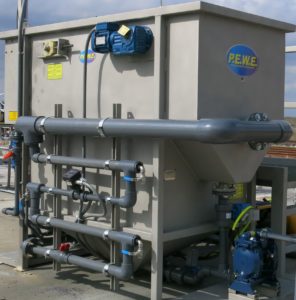
Wastewater treatment is a complex puzzle, and for many facility operators, removing total suspended solids from a waste stream is one of the most critical pieces. Whether the goal is to meet strict regulatory permit requirements or simply to avoid excessive discharge costs, the universal objective remains the same: remove as many solids as possible at the lowest possible cost. While traditional clarifiers have long been used to settle solids out of water, dissolved air flotation systems have emerged as a highly effective and preferred alternative for many industrial applications. Unlike clarifiers that rely on gravity to drag particles down, DAF uses micro air bubbles to float solids to the surface. This approach is often easier to troubleshoot and capitalizes on the fact that many industrial solids naturally want to float.
Before diving into the hardware, it is essential to understand the basic fluid dynamics at play inside a DAF unit. The entire process hinges on a delicate balance between two competing directional forces: the horizontal velocity of the water flowing through the system and the vertical velocity of the suspended solids trying to rise to the surface. When water enters the vessel, it carries solids with it. For the system to work, those solids must have enough time to float to the top and form a blanket before the horizontal flow of the water sweeps them out of the exit. In practical terms, this means the vertical rise rate of a particle must be equal to or greater than the designed rise rate of the vessel. If the water moves too fast or the particles float too slowly, the solids will escape with the treated effluent, completely defeating the purpose of the machine.
Designing or evaluating a system requires a close look at three critical parameters that dictate its efficiency. The first of these is the hydraulic loading rate, which is the flow of water measured in gallons per minute divided by the square footage of the system’s surface area. A rule of thumb for this parameter is to maintain a rate between 0.3 and 3.0 gallons per minute per square foot. To ensure a system is correctly matched to a waste stream, perform a lab test using a graduated cylinder and an air sparger to measure the specific rise rate of a water sample. By dividing the anticipated flow rate by this rise rate, you can determine the minimum required surface area, which is typically then increased by a safety margin to roughly 125% of the required minimum.
The second parameter is the solids loading rate. While the hydraulic rate deals with water volume, the solids loading rate addresses the sheer physical mass of the sludge accumulating on the surface. This is calculated as the pounds of solids per square foot of surface area per hour of operation. There is a physical limit to how much sludge a unit can hold before the blanket becomes too heavy, breaks apart, and sinks back into the clean water. An optimal solids loading rate falls between 1.0 and 6.0 pounds per square foot per hour. In a well-tuned system, this sludge builds up evenly across the surface into a thick, oatmeal-like consistency before being gently scraped away by a mechanical chain and paddle system.
The third vital parameter is the air to solids ratio. This calculation determines exactly how much air is needed to float a given volume of solids, expressed as pounds of air to pounds of solids. As a general guideline, a ratio of 0.005 to 0.06 pounds of air per pound of suspended solids is considered ideal. However, not all aeration systems are created equal. Depending on the mechanical quality of the equipment generating the bubbles, an efficiency factor of 50 to 95 percent must often be applied to real-world calculations to ensure accurate sizing.
To successfully float microscopic particles, they must be chemically bound together into larger, buoyant masses known as floc. This is achieved using a combination of coagulants and flocculants. This can be fully automated, eliminate messy mixing problems like unblended polymer, and allow operators to easily switch products when wastewater characteristics change.
To maximize the efficiency of these liquid chemicals, a flow-proportional make-down system should be utilized. By tying a chemical dosing pump to a 4 to 20 milliamp signal from an inline flow meter, the system automatically injects the exact amount of chemistry needed for the real-time water flow. This rapidly pays for itself through chemical savings and prevents the wasteful practice of manual, static dosing during widely fluctuating flows.
When it comes to the physical construction of the vessel, modern engineering has provided significant upgrades over traditional designs. Instead of large, open tanks that consume massive amounts of floor space, modern systems utilize plate packs. These inclined, stacked surfaces drastically increase the available separation surface area within a highly compact footprint. This design improves laminar fluid flow and gives the unit a much wider tolerance for flow and load variations. Furthermore, building the vessel out of stainless steel provides excellent durability and corrosion resistance, unlike cheaper carbon steel that corrodes easily or overly bulky plastic alternatives that lack structural strength.
The aeration system that generates the microscopic bubbles is the heart of the machine. The most effective modern systems employ regenerative turbine technology. Rather than relying on clunky, energy-intensive air compressors, these specialized pumps dissolve air directly into the water stream using a minimal amount of electricity, generating a massive volume of highly efficient 20 to 30 micron bubbles that easily lift the newly formed flocs to the surface.
Finally, operators must account for the fact that not all solids will float. Heavy materials like sand and grit will inevitably sink. Flat-bottom tanks are notoriously difficult to clean and maintain when solids settle. To solve this, facilities should invest in a sloped-bottom or cone-bottom design. The best of these designs feature automated, external suction pumps that easily evacuate settled sludge without relying on internal mechanical bottom scrapers that are highly prone to wear.
Even the most advanced technology will fail if it is pushed beyond its physical limits. One of the most common and damaging mistakes made during facility upgrades is undersizing the equipment to save on initial capital budgets. When a system is forced to process more water or solids than it was explicitly designed for, the quality of the treatment plummets immediately. By investing in properly sized equipment and following these core operational principles, facilities can ensure reliable, cost-effective, and comprehensive wastewater treatment.