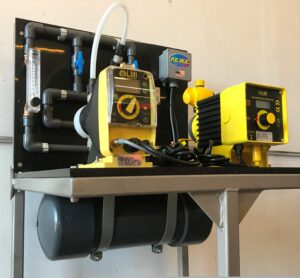
Chemical feed stations are the backbone of modern water treatment. These integrated components of tanks, pumps, mixers, valves, sensors, and controls deliver precise amounts of treatment chemicals into water streams. Properly designed feed stations ensure that disinfection, pH control, coagulation/flocculation, occur reliably and efficiently. Feed systems typically use small AOD pumps to dose liquids. Sensors and PLC controllers monitor performance and adjust feed rates in real time. To prevent contamination and hazards, all chemicals must have labels and SDS. Some chemical tanks require secondary containment that has capacity of the largest tank plus rainfall. This article reviews what chemical feed stations are, their main components and their roles in key treatment steps.
What Is a Chemical Feed Station?
A chemical feed station is an integrated assembly that delivers precise quantities of treatment chemicals into a wastewater stream at controlled flow rates. Its core function is automated dosing: it stores chemicals, and injects them into the process at rates set by operators. A poorly designed feed station will waste chemical, produce inconsistent water quality, and raise maintenance costs. In contrast, a good feed station helps meet treatment targets reliably and efficiently.
Feed stations are sometimes called pump skids, metering skids, or dosing centers. They automate the addition of disinfectants, coagulants, pH adjusters, polymers, nutrients, and other specialty chemicals. Though all designs share these goals, configurations vary widely by scale and purpose.
Key Components
- Storage and Supply Tanks: Chemicals arrive and are stored in bulk. These tanks may be made of fiberglass-reinforced plastic (FRP), high-density polyethylene (HDPE), or stainless steel, depending on the chemical. A smaller day tank or mixing tank is usually connected downstream of bulk storage. Day tanks provide a buffer so the bulk supply is never fully drawn down. All chemical storage must have secondary containment capable of holding the largest tank volume plus rainwater.
- Mixers: Dry chemical feeders deliver powder into a slurry tank. Water is added and agitated to make a uniform solution. Vertical propeller or air-driven mixers are common. Mixers may also be used in day tanks to keep liquid feed homogenous.
- Metering Pumps: The core of the feed station is the metering pump. Nearly all feed systems use a positive-displacement metering pump to inject liquid chemicals. Diaphragm pumps are most common, because they can accurately deliver from a few mL/hr up to several hundred gallons per hour and can withstand high discharge pressure. Pumps often have variable stroke or speed for on-the-fly adjustment. Each pump outlet typically has a check valve, pressure relief valve, and flow meter line.
- Instrumentation and Controls: pH probes and flow meters are often placed downstream to verify the chemical effect. These signals feed a PLC or controller that can automatically adjust pump output. Control panels may also receive plant flow signals to run pumps proportionally. Alarms warn of conditions (e.g. low tank level, pump failure, loss of flow). In practice, pump standby arrangements, backup power, and remote monitoring are common for critical feeds.
How Feed Stations Operate
Chemical feed can be continuous or batch. Batch dosing involves discharging pre-measured “batches” of chemical at intervals. Continuous feed means a constant trickle of chemical. Most water purification processes require continuous feed. Where continuous feed is needed, pumps are usually run continuously and configured to flow or demand.
Flow-proportional control is common: the chemical dose is set in mg/L, and a flow meter tells the controller how fast to pump. Modern systems may use PLCs. The flow signal is multiplied by the desired concentration, and the controller adjusts pump stroke or frequency. When designing a feed station, engineers calculate the required feed rate from the plant flow and target dose. Pumps are sized for maximum day’s flow.
Roles in Treatment Processes
- Coagulation/Flocculation: Powdered coagulants are often made into slurries or solutions in large dissolving tanks and fed by pumps. These dense solutions typically require positive-displacement metering pumps. Polymer is commonly fed downstream of coagulants to aid floc formation. The feed station for coagulation may be sizable because of high dosage rates (e.g. 10–100 mg/L of polymer or coagulant).
- pH Adjustment: To optimize treatment and protect pipes, feed systems add acids. For example, if source water is too alkaline, acid is dosed to lower pH before softening. Conversely, if treated water pH is low, caustic soda is added. These feeds use similar pump/tank setups but often require stronger containment.
Chemical feed stations are a vital part of wastewater treatment. They provide the infrastructure to store, dose, and monitor the chemicals that drive disinfection, pH control, coagulation, and corrosion protection. By combining mechanical components with instrumentation and safety features, a well designed feed station ensures water quality goals are met reliably.